|
[ Exercise 12 ]
- It is a fact that engineers select an appropriate variable
and treat the transformed observations as though they are normally distributed
with a constant variance.
[ more >>> ]
- Those methods neither require previous knowledge of
how the variables are distributed nor stipulate availability of the
censored data.
[ more >>> ]
-
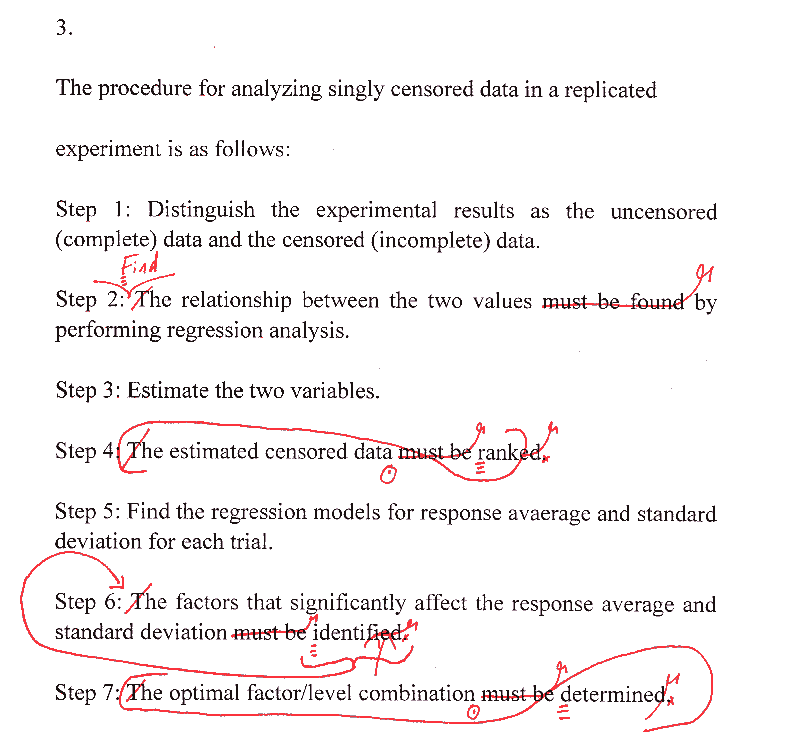
The procedure for analyzing singly censored data in
a replicated experiment is as follows:
Step 1: Distinguish the experimental results
as the uncensored (complete) data and the censored (incomplete) data.
Step 2: Find the relationship between the two
values by performing regression analysis.
Step 3: Estimate the two variables.
Step 4: Rank the estimated censored data.
Step 5: Find the regression models for response
average and standard deviation for each trial.
Step 6: Identify the factors that significantly
affect the response average and standard deviation.
Step 7: Determine the optimal factor/level combination.
[ more >>> ]
- The derived model extends an earlier concept [1] and
helps industrial managers in determining a feasible number of replenishments.
[ more >>> ]
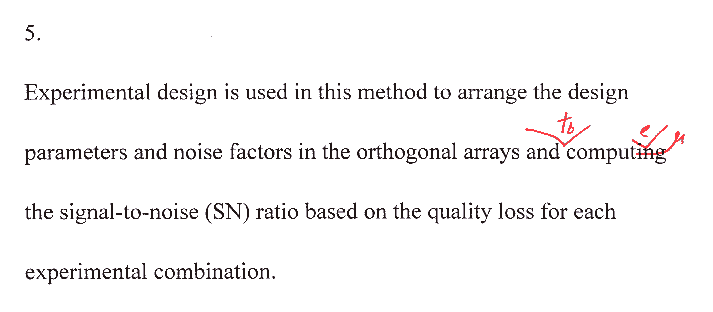
- Experimental design is used in this method to arrange
the design parameters and noise factors in the orthogonal arrays and
to compute the signal-to-noise (SN) ratio based on the quality loss
for each experimental combination.
[ more >>> ]
- The relative importance of each response can be transformed
into a fuzzy number through means of establishing a formal scale system
that can convert linguistic terms into their corresponding fuzzy numbers
and expressing the relative importance of each response by the linguistic
term.
[ more >>> ]
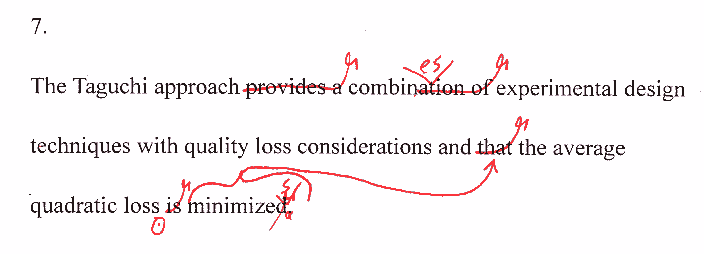
- The Taguchi combines experimental design techniques
with quality loss considerations and minimizes the average quadratic
loss.
[ more >>> ]
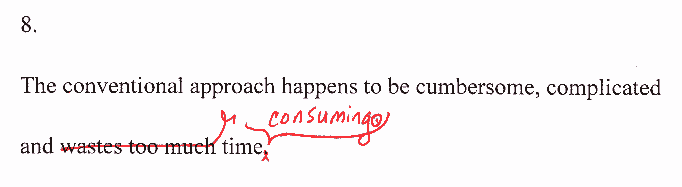
- The conventional approach happens to be cumbersome,
complicated and time consuming.
[ more >>> ]
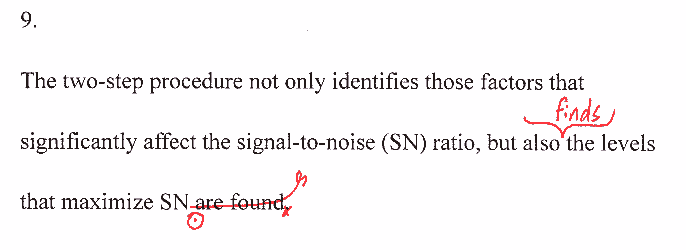
- The two-step procedure not only identifies those factors
that significantly affect the signal-to-noise (SN) ratio, but also finds
the levels that maximize SN.
[ more >>> ]
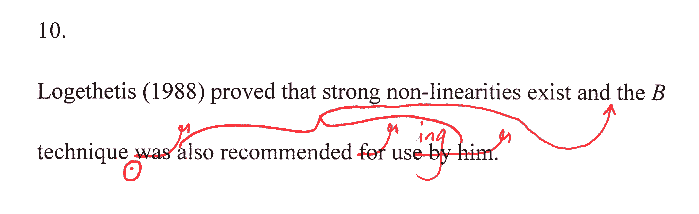
- Logethetis (1988) proved that strong non-linearities
exist and also recommended using the B technique.
[ more >>> ]
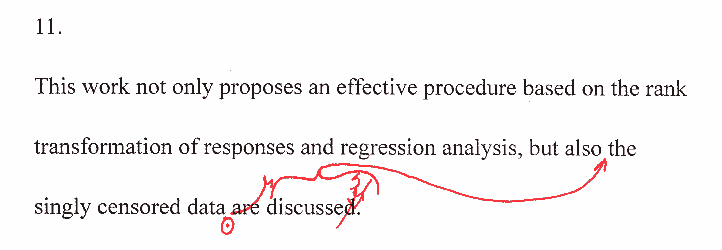
- This work not only proposes an effective procedure
based on the rank transformation of responses and regression analysis,
but also discusses the singly censored data.
[ more >>> ]
-
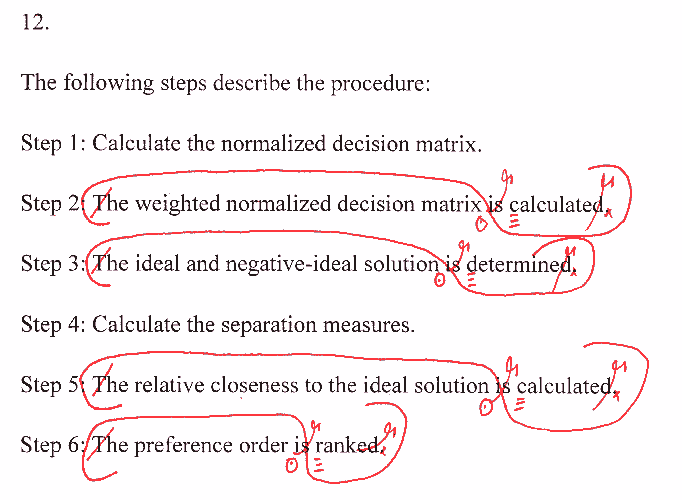
The following steps describe the procedure:
Step 1: Calculate the normalized decision matrix.
Step 2: Calculate the weighted normalized decision matrix.
Step 3: Determine the ideal and negative-ideal solution.
Step 4: Calculate the separation measures.
Step 5: Calculate the relative closeness to the ideal solution.
Step 6: Rank the preference order.
[ more >>> ]
|